The right of access
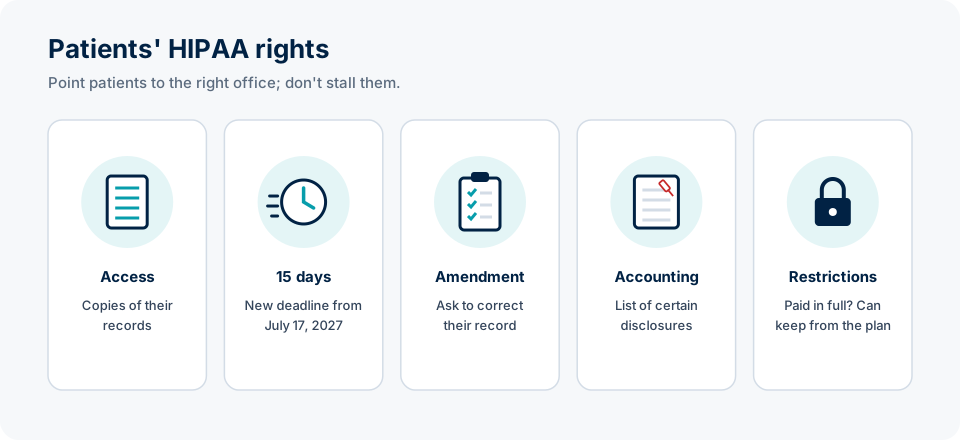
Patients may inspect and get copies of their PHI in a designated record set, including electronic copies, and may direct a copy to a third party (45 CFR 164.524). Denials are allowed only on narrow grounds. A provider may not hold records hostage over an unpaid bill.
Deadlines: today and after the 2026 final rule
- Today: act on a request within 30 days, with one 30-day extension if the patient is told why in writing.
- New: HHS published a final rule on November 19, 2026, effective January 18, 2027, with compliance required by July 17, 2027. It requires action as soon as practicable and no later than 15 calendar days, with one extension of up to 30 days if the patient is told in writing within the first 15 days. It also bars unreasonable identity-verification hurdles and fees for inspection or for electronic access through an online method, and drops the signed acknowledgment of the Notice of Privacy Practices.
Your part at the front line: don't decide access requests yourself. Take the request seriously, help the patient reach Health Information Management or the privacy office the same day, and never tell a patient “you can't have your records.”
Other rights
- Notice of Privacy Practices: patients get a plain-language notice of how their information is used and their rights (164.520).
- Amendment: patients may ask to correct their record. The entity acts within 60 days, with one 30-day extension, and may deny with a written reason, such as the record being accurate and complete (164.526).
- Accounting of disclosures: a list of certain disclosures in the prior six years. TPO disclosures and disclosures to the patient are not included (164.528).
- Restrictions: patients may ask to limit uses. The entity usually doesn't have to agree, with one big exception: if the patient paid in full out of pocket, it must agree not to disclose that item or service to the health plan for payment or operations (164.522(a)(1)(vi)).
- Confidential communications: patients may ask to be contacted another way, such as a different phone number, and providers must accommodate reasonable requests (164.522(b)).
Complaints
Patients may complain to the covered entity or to HHS OCR, and the entity may not retaliate against them for doing so.
Key terms · tap to flip
Check your understanding
Knowledge check
Pick an answer to see the explanation. Get them all right to complete the lesson.
Part of the free MedRise HIPAA Privacy & Security Training. Built on the HIPAA Privacy, Security and Breach Notification Rules (45 CFR Parts 160 and 164).