Civil penalties
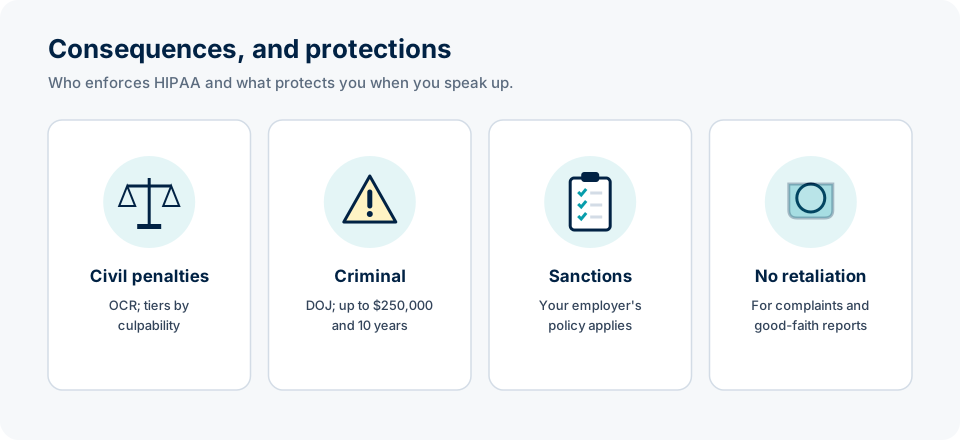
HHS's Office for Civil Rights investigates complaints, breach reports and compliance reviews. Most cases end with corrective action; serious ones end in resolution agreements or civil money penalties. Penalties come in four tiers, from violations the entity didn't know about to willful neglect that wasn't corrected, with per-violation amounts and annual caps that HHS adjusts for inflation. Since HITECH, state attorneys general can also bring HIPAA cases.
Criminal penalties
Under 42 U.S.C. 1320d-6, a person who knowingly obtains or discloses individually identifiable health information in violation of HIPAA faces, as enforced by the Department of Justice:
- Up to $50,000 and up to 1 year in prison
- Up to $100,000 and up to 5 years if done under false pretenses
- Up to $250,000 and up to 10 years if done with intent to sell, transfer or use it for commercial advantage, personal gain or malicious harm
Workplace sanctions
Covered entities must have and apply sanctions against workforce members who violate privacy policies (164.530(e)). For students and observers that can mean removal from the rotation and a report to your school, which can follow you into residency applications.
Your protections
- Whistleblowers: a workforce member who believes in good faith that their employer is acting unlawfully may disclose PHI to a health oversight agency or an attorney for that purpose (164.502(j)).
- No retaliation: covered entities may not intimidate or retaliate against anyone for filing a complaint, cooperating with an investigation or opposing a violation (164.530(g)).
One-page review
- You are workforce; HIPAA applies to you now.
- PHI is any identifiable health or payment information, in any form.
- Share for treatment freely, everything else only as permitted, and always the minimum necessary outside treatment.
- Help patients use their rights. The access deadline drops to 15 days at the July 17, 2027 compliance date.
- Lock it, encrypt it, don't share logins, report phishing.
- No patient posts, no PHI in public AI tools, no snooping.
- Report problems right away.
Covered entities keep HIPAA policies and required documentation for six years (164.530(j)).
Key terms · tap to flip
Check your understanding
Knowledge check
Pick an answer to see the explanation. Get them all right to complete the lesson.
Part of the free MedRise HIPAA Privacy & Security Training. Built on the HIPAA Privacy, Security and Breach Notification Rules (45 CFR Parts 160 and 164).