Measles is no longer considered eliminated in the United States. The Pan American Health Organization announced on Nov. 17, 2026 that endemic transmission has been re-established in the U.S., Mexico and Bolivia, ending a U.S. status held for 26 years.
The U.S. was declared measles-free in 2000, according to CDC. The change means one measles lineage has now spread inside the country for more than 12 months, so a febrile patient with a rash in a U.S. emergency department or clinic can no longer be treated as a rare imported case.
For students, residents and IMGs starting U.S. rotations, the stakes are practical: measles is airborne, and PAHO says each case infects 12 to 18 others on average where people are not immune. Missing it in a waiting room exposes patients and staff, and exposed staff without documented immunity can be kept off work.
One lineage, 12 months, three countries
The decision came from PAHO's Regional Monitoring and Re-Verification Commission for measles and rubella elimination, which met Nov. 10 to 13. PAHO's director accepted its assessment, the PAHO release said.
The rule is narrow. Under the regional framework, a country loses elimination status when the same genotype and lineage circulates without interruption for at least 12 months; imported cases alone do not count, PAHO's question-and-answer page explains.
By PAHO's timeline, the U.S. chain began Jan. 20, 2025 and crossed the 12-month line on Jan. 20, 2026. Mexico crossed it on Feb. 1, 2026 and Bolivia on April 16, 2026. Canada lost its status in November 2025.
CDC counts 5,412 confirmed U.S. cases in 2026 as of Nov. 12, reported by 47 jurisdictions, with 43 new outbreaks this year and about 96% of cases linked to outbreaks. CDC lists 6 deaths so far this year and notes the count may change.
Across the Americas, PAHO recorded 58,213 confirmed cases as of Nov. 13, compared with 12,806 in the same period of 2025, more than four times as many. The largest share of cases is in people aged 20 to 29, while infants under 1 have the highest incidence, PAHO says.
CDC points to vaccination gaps. In its joint statement, it said MMR coverage among U.S. kindergartners fell from 95.2% in 2019-2020 to 92.7% in 2023-2024. PAHO's target is at least 95% two-dose coverage in every community, not just as a national average.
The measles clock every trainee should know
CDC's clinical diagnosis fact sheet lays out a predictable sequence, and it is the same one board-style questions test:
- Incubation: typically 11 to 12 days from exposure to the first symptoms.
- Prodrome: fever with cough, coryza or conjunctivitis.
- Koplik spots: tiny white spots inside the mouth may appear 2 to 3 days after symptoms start.
- Rash: appears 2 to 4 days after the prodrome, starts on the head and face, spreads downward and lasts 5 to 6 days.
- Contagious window: 4 days before through 4 days after rash onset.
With the largest regional share of cases in people in their 20s, this is not only a pediatrics problem.
Five rules to act on during a shift
These come from CDC's infection control guidance for health care settings and its measles vaccine recommendations:
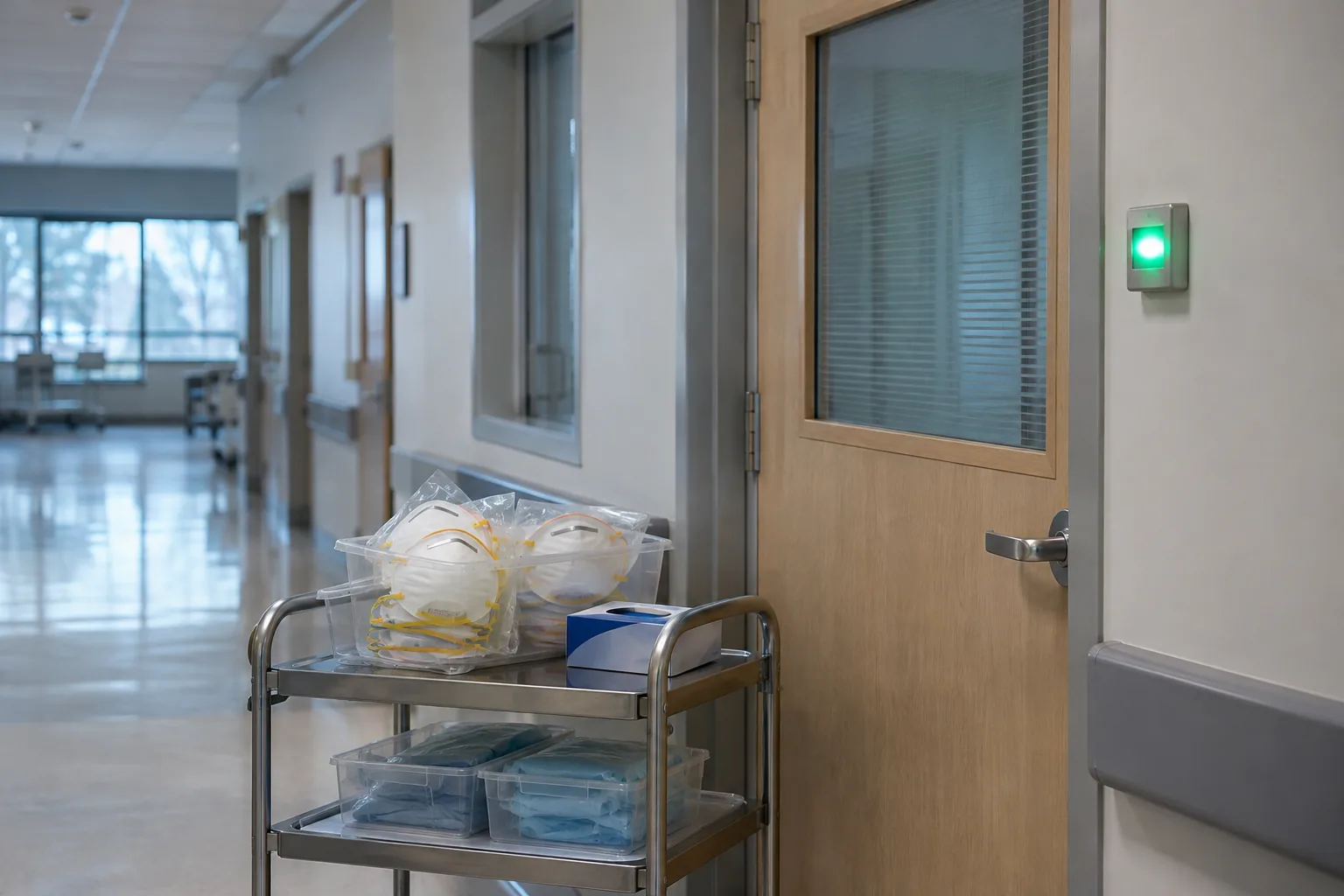
- Now: mask the patient and move them to an airborne infection isolation room right away. Staff wear a fit-tested N95 or better, regardless of their own immunity.
- Now, not after the lab result: CDC asks clinicians to report a suspected case immediately to the local or state health department. Testing is a throat or nasopharyngeal swab for RT-PCR plus serum for measles IgM.
- 2 hours: measles can stay infectious in room air for up to 2 hours, so CDC advises leaving the room empty for up to 2 hours after the patient leaves.
- 72 hours and 6 days: MMR vaccine can serve as post-exposure prophylaxis if given within 72 hours of exposure; immune globulin, within 6 days.
- 4 days: airborne precautions continue for 4 days after rash onset, or for the whole illness in immunocompromised patients.
Check your own records too. CDC accepts four kinds of evidence of measles immunity for health care personnel: written proof of 2 vaccine doses, a positive measles IgG, lab-confirmed past infection, or birth before 1957 (CDC still advises vaccinating those staff if they lack other evidence). An equivocal IgG counts as negative.
CDC tells facilities to make sure every worker has that evidence, so IMGs preparing for U.S. observerships or residency onboarding should keep dated vaccine records or lab reports with their other documents.
What comes next: a new 12-month clock
To regain the status, a country has to show it has interrupted endemic transmission for at least 12 consecutive months and carry out a corrective plan for vaccination, surveillance and outbreak response, PAHO says.
The path is slow. Brazil lost its status in 2019, stopped transmission in 2022 and regained it in November 2024. Canada declared its outbreak over on Oct. 19, 2026, which did not restore its status automatically.
CDC says it has sent about $100 million to health departments since August for outbreak response and laboratory capacity. Its director cautioned that the label is not the point: "The measles elimination designation is not what protects Americans." The designation tracks whether one lineage keeps spreading, not the risk in any one community.
PAHO's director called it a serious warning, "but it is not an irreversible setback."
For U.S. trainees, measles has moved from a textbook photo to a diagnosis to rule out in real patients. The two-hour room rule and the 72-hour vaccine window are the details most likely to matter on the next shift.
Sources
- PAHO, measles elimination status release (Nov. 17, 2026)
- PAHO, Measles in the Americas: Questions and Answers (Nov. 17, 2026)
- CDC, Joint Statement: Loss of U.S. Measles Elimination Status (Nov. 17, 2026)
- CDC, Measles Cases and Outbreaks (updated Nov. 13, 2026)
- CDC, Interim Infection Prevention and Control Recommendations for Measles in Healthcare Settings
- CDC, Measles Clinical Diagnosis Fact Sheet
- CDC, Measles Vaccine Recommendations
- CDC, History of Measles
MedRise Medical News summarizes public announcements and research for education only. It is not medical, legal or immigration advice.