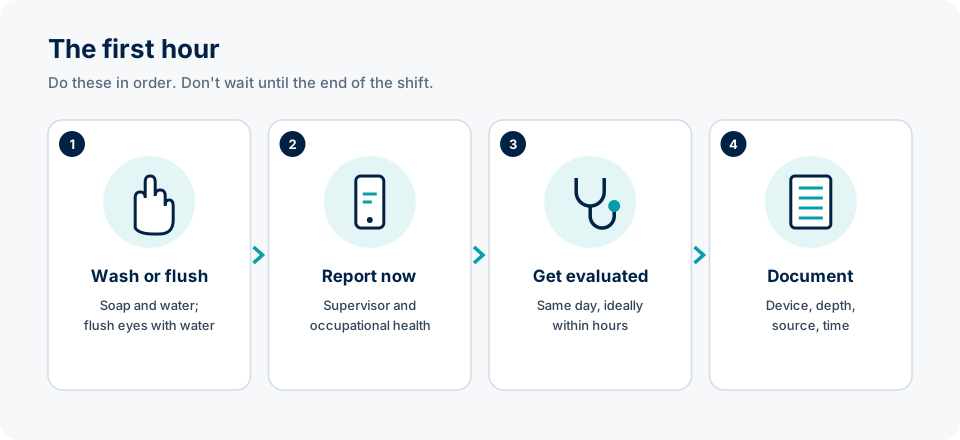
Step 1: First aid
- Needlesticks and cuts: wash with soap and water.
- Splashes to nose, mouth or skin: flush with water.
- Eyes: irrigate with clean water, saline or a sterile irrigant. Remove contact lenses.
Don't squeeze or “milk” the wound, and don't apply bleach, alcohol or other caustic agents: there's no evidence they reduce risk, and caustic agents damage tissue.
Step 2: Report immediately
Tell your supervisor, preceptor or charge nurse right away, and contact employee health or follow your facility's exposure process. In the middle of a procedure, step out as soon as it's safe and hand off. Reporting fast is what makes PEP possible within the window where it works best.
Students and observers: you may not be an employee of the hospital, but you still need the same evaluation. Know your school's needlestick policy before your first rotation: who to call, where to go after hours, and how costs are handled. Report first; sort out billing later.
Step 3: Get a medical evaluation the same day
Go to employee health, or the emergency department after hours. Bring or note:
- Time of the exposure
- Type of injury and device (hollow-bore? gauge? visible blood?)
- Depth and body site
- Body fluid involved
- Source patient's identity (for testing) and any known status
- Your own hepatitis B vaccination and antibody (titer) results, and current medicines or pregnancy
Expert help
The Clinician Consultation Center's PEPline (888-448-4911) gives clinicians expert advice on occupational exposures to HIV and hepatitis. Clinicians shouldn't delay starting PEP while waiting for a consult when it's indicated.
Step 4: Document
An exposure incident report captures the route, circumstances and device. For employees, OSHA requires the employer to record the circumstances and keep the records confidential.
Key terms · tap to flip
Check your understanding
Knowledge check
Pick an answer to see the explanation. Get them all right to complete the lesson.
Part of the free MedRise Exposure Response & PEP Training. Built on OSHA 29 CFR 1910.1030(f), the 2025 U.S. Public Health Service occupational HIV PEP guidelines and CDC hepatitis guidance.