When to start
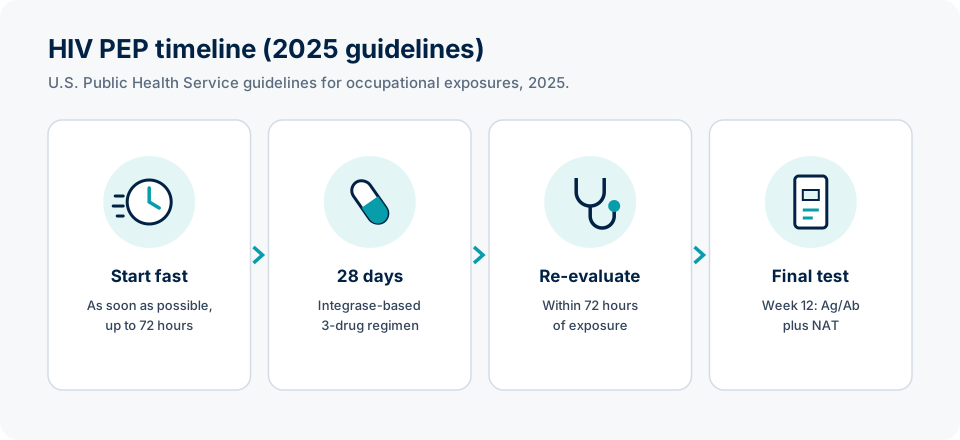
Under the 2025 U.S. Public Health Service guidelines for occupational HIV exposures, PEP should start as soon as possible, up to 72 hours after the exposure. If a high-risk exposure is discovered after 72 hours, the clinician consults a provider with HIV expertise. That's why you report immediately, even at 3 a.m. The 2025 guidelines also say the exposed health care worker should be part of the decision about whether to start PEP.
What it is
PEP is a 28-day course of antiretroviral medicines. The 2025 guidelines changed the preferred regimens to integrase-based combinations:
- Bictegravir/emtricitabine/tenofovir alafenamide, a single tablet once a day, or
- Dolutegravir plus tenofovir (alafenamide or disoproxil fumarate) plus emtricitabine or lamivudine.
These are better tolerated than older regimens, which makes finishing the course easier. The clinician chooses the drugs, considering pregnancy, kidney function, other medicines and any known resistance in the source's virus, with expert consultation when needed. The 2025 guidelines also dropped routine blood tests for drug side effects unless baseline tests are abnormal or symptoms appear.
Finish the course. Stopping early because of side effects is a common reason PEP fails. If you can't tolerate it, go back for evaluation: there are other options. PEP and follow-up testing stop if the source patient tests HIV-negative.
Follow-up testing (2025)
- Baseline: a rapid or lab-based 4th-generation HIV antigen/antibody test as soon as possible. People who took long-acting injectable cabotegravir PrEP in the past 12 months also get a nucleic acid test (NAT), with expert input.
- Re-evaluation within 72 hours of the exposure, to review the source's results, counsel you and check how you're tolerating PEP.
- Interim test at 4 to 6 weeks (lab-based antigen/antibody test plus NAT) only if PEP was started more than 24 hours after the exposure.
- Final test at week 12: lab-based antigen/antibody test plus NAT.
This replaces the older schedule (6 weeks, 12 weeks and 6 months) that some sources still repeat.
During follow-up
Until your final HIV test, take precautions to prevent possible secondary transmission: use condoms, don't donate blood, plasma, organs or semen, and discuss pregnancy and breastfeeding with your clinician. Report any illness like fever, rash or swollen glands; it could be acute HIV.
Getting it in time
After hours, the emergency department can start PEP. Ask for a starter supply until you can see occupational health. If you were exposed but didn't report, it's still worth going now if you're within 72 hours.
Key terms · tap to flip
Check your understanding
Knowledge check
Pick an answer to see the explanation. Get them all right to complete the lesson.
Part of the free MedRise Exposure Response & PEP Training. Built on OSHA 29 CFR 1910.1030(f), the 2025 U.S. Public Health Service occupational HIV PEP guidelines and CDC hepatitis guidance.