How it spreads
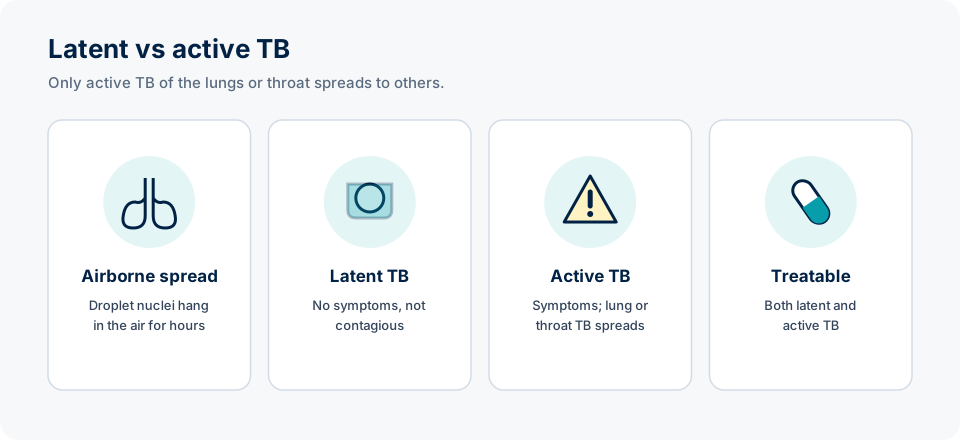
Tuberculosis is caused by Mycobacterium tuberculosis. A person with active TB disease of the lungs or throat releases tiny particles, called droplet nuclei, when they cough, speak, sing or sneeze. These are small enough to stay suspended in room air for hours and to reach the lungs of someone who breathes them in. That's why TB control is about air, not hands.
TB is not spread by shaking hands, sharing food or drinks, touching bed linens or surfaces, or kissing.
Latent TB infection vs TB disease
- Latent TB infection (LTBI): the bacteria are alive but inactive. The person has no symptoms, feels well, and cannot spread TB. A TB blood test or skin test is usually positive. Without treatment, some people go on to develop TB disease.
- TB disease (active TB): the bacteria are multiplying. The person usually has symptoms and, if the disease is in the lungs or throat, can spread it.
Symptoms that should make you think TB
- Cough lasting 3 weeks or longer
- Coughing up blood or sputum
- Chest pain
- Fever, chills and night sweats
- Unexplained weight loss, loss of appetite, fatigue
Think TB when these symptoms appear in someone with risk factors: recent arrival from a country where TB is common, known contact with TB, HIV infection or other immune suppression, homelessness or time in a correctional facility, or a history of untreated LTBI.
Who's at higher risk of progressing
People with HIV, people on immune-suppressing drugs (such as TNF-alpha inhibitors or long-term steroids), people with diabetes, recent infection (within the past 2 years), and young children are more likely to go from latent infection to disease. That's why treating latent TB matters.
Key terms · tap to flip
Check your understanding
Knowledge check
Pick an answer to see the explanation. Get them all right to complete the lesson.
Part of the free MedRise TB & Respiratory Protection Training. Built on the CDC/NTCA 2019 health care personnel TB recommendations, CDC TB infection control guidance and OSHA 29 CFR 1910.134.