What counts as an exposure
Typical examples: sharing air space with a patient with infectious TB before they were isolated, being in the room without a respirator, or a respirator failure during an aerosol-generating procedure. Infection prevention decides who is a contact, based on how long and how close the exposure was and how infectious the patient was.
The contact investigation
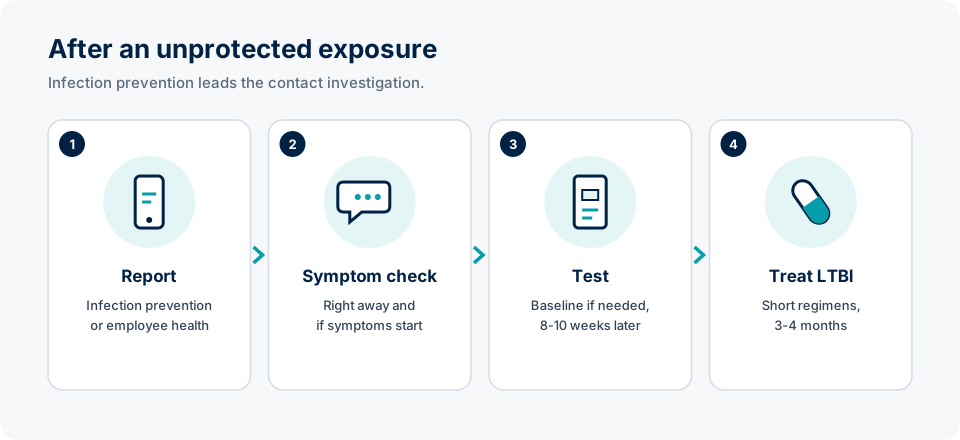
- Report the possible exposure to infection prevention or employee health.
- Symptom evaluation right away.
- Testing: a baseline IGRA or TST if you don't have a recent negative result, and a repeat test 8 to 10 weeks after the exposure ended, because it takes that long for a new infection to show up on testing.
- A chest X-ray and medical evaluation if a test converts to positive or you have symptoms.
Don't wait for the 8-week test if you get sick. A cough that lasts weeks, fever, night sweats or weight loss should be reported right away.
If you have latent TB
Treating LTBI prevents TB disease later. CDC and NTCA's 2020 treatment guidelines prefer short, rifamycin-based regimens:
- 3HP: isoniazid and rifapentine once weekly for 3 months
- 4R: rifampin daily for 4 months
- 3HR: isoniazid and rifampin daily for 3 months
Longer isoniazid-only regimens are alternatives. Your clinician chooses based on drug interactions, other conditions and pregnancy. Workers with latent TB can keep working: they aren't contagious.
Working with TB disease
A health care worker diagnosed with infectious TB is excluded from work until they're no longer infectious, as determined by their clinician and the facility's infection prevention program.
Review
- Only active lung or throat TB spreads, through the air.
- Baseline screening at hire; no routine annual test without exposure; annual education for all.
- Think TB, mask the patient, isolate in an AIIR with the door closed.
- Medical evaluation, fit test and training before you wear an N95; seal check every time.
- Report exposures; test at baseline and 8 to 10 weeks.
Key terms · tap to flip
Check your understanding
Knowledge check
Pick an answer to see the explanation. Get them all right to complete the lesson.
Part of the free MedRise TB & Respiratory Protection Training. Built on the CDC/NTCA 2019 health care personnel TB recommendations, CDC TB infection control guidance and OSHA 29 CFR 1910.134.