Why HazCom exists
Hospitals and clinics are chemical workplaces: disinfectants, sterilants, fixatives, lab reagents, hazardous drugs and compressed gases. The Hazard Communication Standard makes sure that chemical manufacturers and importers classify each chemical's hazards and pass that information down the chain on labels and safety data sheets, and that employers train workers to use it.
What your employer must do
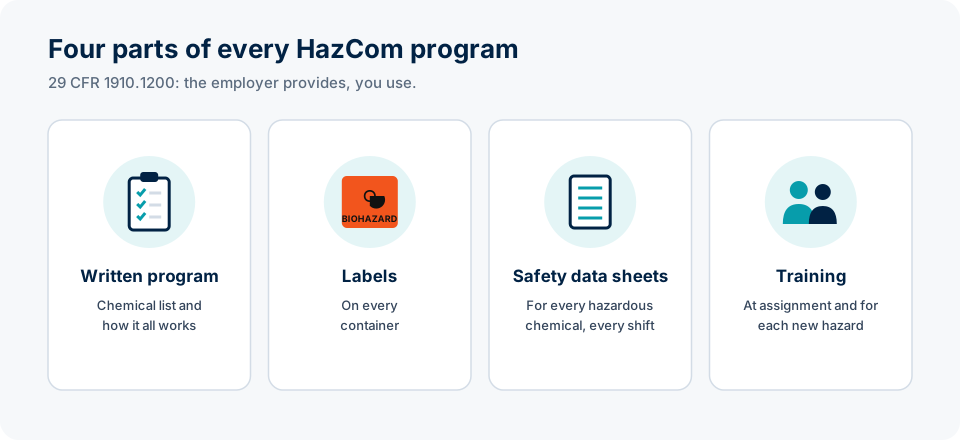
- Written hazard communication program (1910.1200(e)): how the workplace handles labels, SDS and training, with a list of the hazardous chemicals present, plus how employees learn about non-routine tasks and how other employers' workers are informed.
- Labels on containers (f).
- Safety data sheets for each hazardous chemical, readily accessible during each work shift (g).
- Information and training at initial assignment and whenever a new chemical hazard is introduced (h).
Who it covers
Any employee who may be exposed to hazardous chemicals under normal conditions of use or in a foreseeable emergency. Some products are exempt, such as consumer products used the way a consumer would use them, and drugs in solid, final form for direct administration to the patient, like tablets. Most hospital disinfectants, lab chemicals and many drugs during preparation are covered.
The 2024 update and its deadlines
OSHA published an update on May 20, 2024 that aligns the HCS more closely with the GHS and clarifies labeling rules, including for small containers. In January 2026 OSHA extended each compliance date by four months. For employers:
- November 20, 2026: for substances, update workplace (in-house) labels as needed, update the HazCom program, and train employees on newly identified hazards.
- May 19, 2028: the same for mixtures.
Until those dates, employers may comply with either the 2012 or the 2024 version of the standard.
For trainees: you don't run the program, but you are expected to read labels, find the SDS and follow the precautions. On day one of a rotation, ask where the SDS are kept and how to reach them.
Key terms · tap to flip
Check your understanding
Knowledge check
Pick an answer to see the explanation. Get them all right to complete the lesson.
Part of the free MedRise Hazard Communication (GHS) Training. Built on OSHA's Hazard Communication Standard (29 CFR 1910.1200), 2024 update.