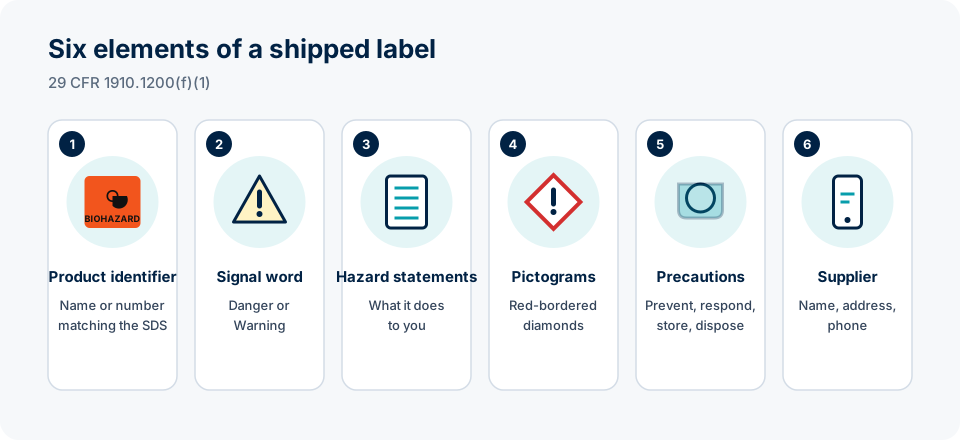
The shipped-container label
Manufacturers, importers and distributors must label each container they ship with (1910.1200(f)(1)):
- Product identifier: the name or number used on the SDS, so you can match them.
- Signal word: Danger for more severe hazards, Warning for less severe ones. Only one appears, and Danger wins if both would apply.
- Hazard statements: fixed phrases describing the nature and degree of the hazard, such as “Causes severe skin burns and eye damage.”
- Pictograms: black symbols in a red-bordered diamond.
- Precautionary statements: what to do to prevent exposure, respond, store and dispose, such as “Wear eye protection” or “IF IN EYES: Rinse cautiously with water for several minutes.”
- Name, address and phone number of the chemical manufacturer, importer or other responsible party.
Workplace labels
When a chemical is transferred into another container in the workplace, such as a spray bottle of diluted disinfectant, the employer may use either the full shipped-label information or the product identifier plus words, pictures, symbols or a combination that give at least the general hazard information (1910.1200(f)(6)). Labels must be legible, in English (other languages may be added) and prominent.
The portable container exception
You don't have to label a portable container if you filled it from a labeled container and it is for your immediate use during your shift (1910.1200(f)(8)). If someone else will use it, or it will sit until tomorrow, label it.
The unlabeled spray bottle: never use a chemical from an unlabeled container, and never pour a chemical into a food or drink container. Unknown liquid? Don't sniff it; ask your supervisor and treat it as hazardous.
When labels get damaged
Labels must stay legible. Report labels that are torn, faded or missing rather than guessing what's inside.
Key terms · tap to flip
Check your understanding
Knowledge check
Pick an answer to see the explanation. Get them all right to complete the lesson.
Part of the free MedRise Hazard Communication (GHS) Training. Built on OSHA's Hazard Communication Standard (29 CFR 1910.1200), 2024 update.