The 16 sections
- Identification
- Hazard(s) identification
- Composition and information on ingredients
- First-aid measures
- Fire-fighting measures
- Accidental release measures
- Handling and storage
- Exposure controls and personal protection
- Physical and chemical properties
- Stability and reactivity
- Toxicological information
- Ecological information
- Disposal considerations
- Transport information
- Regulatory information
- Other information, including date of preparation or last revision
OSHA enforces the content of sections 1 to 11 and 16. Sections 12 to 15 are included for consistency with the GHS but fall under other agencies.
The 30-second read
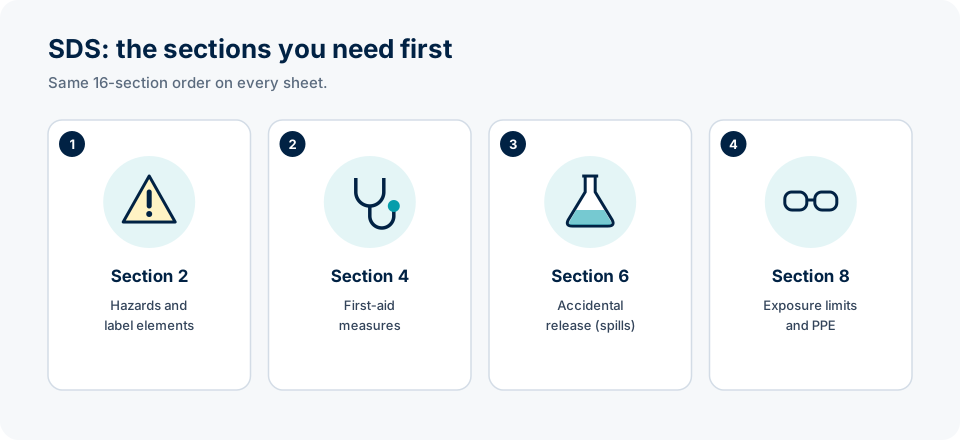
Splash, spill or symptoms? Section 4 for first aid. Before you clean up: section 6 for the spill method and section 8 for the PPE. Wondering if it's dangerous at all: section 2. Storing it next to something else: section 7 and section 10 (incompatibles).
Section 8 in more detail
Section 8 lists exposure limits, such as OSHA permissible exposure limits (PELs) and other recommended limits, plus engineering controls (like local exhaust ventilation) and the specific PPE: glove material, eye and face protection, respiratory protection.
Access is your right
Employers must keep an SDS for each hazardous chemical and make them readily accessible during each work shift in your work area (1910.1200(g)(8)). Electronic access is fine if there are no barriers, such as a password you don't have or a computer that's always down, and there's a backup in an outage or emergency.
When you start somewhere new, find out: Where are the SDS? Binder or electronic? Who do I call if I can't find one?
If you take a chemical exposure to a clinician, bring the SDS (or the product name and manufacturer) with you; it tells them what you were exposed to.
Key terms · tap to flip
Check your understanding
Knowledge check
Pick an answer to see the explanation. Get them all right to complete the lesson.
Part of the free MedRise Hazard Communication (GHS) Training. Built on OSHA's Hazard Communication Standard (29 CFR 1910.1200), 2024 update.