Disinfectants and cleaners
Quaternary ammonium compounds, bleach (sodium hypochlorite), hydrogen peroxide and alcohols are everywhere. Most carry the exclamation mark or corrosion pictogram. Follow the label's dilution and contact time, wear the gloves and eye protection the SDS lists, and use them in ventilated areas.
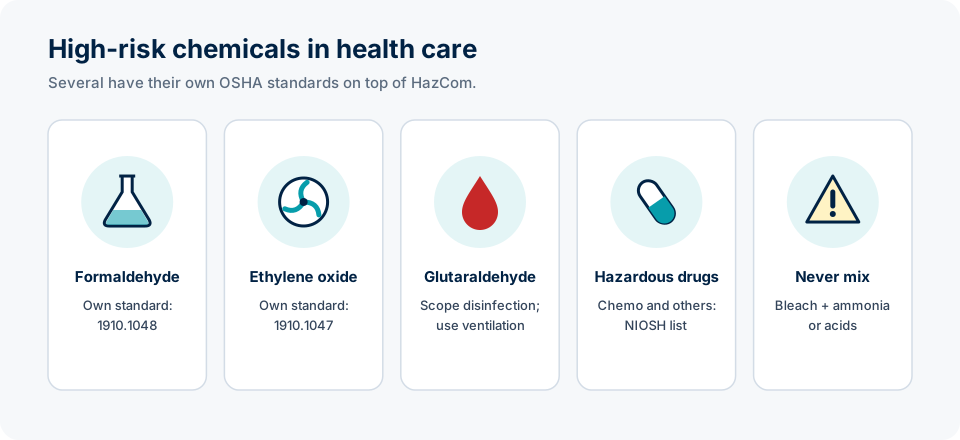
Never mix cleaners. Bleach plus ammonia-containing products releases chloramine gas. Bleach plus acids, such as some toilet-bowl or descaling cleaners, releases chlorine gas. Both can cause serious lung injury. Use one product, rinse, then the next.
High-level disinfectants and sterilants
- Glutaraldehyde and ortho-phthalaldehyde: used for endoscopes; irritants and sensitizers. Use in ventilated areas or enclosed systems with the PPE on the SDS.
- Peracetic acid and hydrogen peroxide sterilants: corrosive oxidizers.
- Ethylene oxide: a gas sterilant that is a carcinogen and flammable. OSHA's own standard (29 CFR 1910.1047) sets a permissible exposure limit of 1 ppm as an 8-hour average.
Fixatives and lab chemicals
Formaldehyde (formalin) is used in pathology, surgery and labs. It is a carcinogen and sensitizer with its own standard, 29 CFR 1910.1048 (PEL 0.75 ppm as an 8-hour average, short-term limit 2 ppm). Keep specimen containers closed and use them in ventilated areas. Clinical and research labs also follow OSHA's Laboratory standard (1910.1450) with a chemical hygiene plan.
Hazardous drugs
Many chemotherapy agents and some other drugs are hazardous to workers who prepare, give or dispose of them. NIOSH publishes a list of hazardous drugs in healthcare settings. Follow your facility's handling procedures: special gloves and gowns, closed-system devices, and designated disposal. (Tablets given directly to patients are exempt from HazCom labeling, but crushing or splitting them can create exposure.)
Gases
Oxygen (oxidizer), nitrous oxide and other anesthetic gases, and CO2 come in pressurized cylinders. Secure cylinders upright, keep oxygen away from flames and oils, and never alter regulators.
Mercury
Older thermometers and devices may contain mercury. Don't vacuum or sweep a mercury spill; follow your facility's spill procedure.
Key terms · tap to flip
Check your understanding
Knowledge check
Pick an answer to see the explanation. Get them all right to complete the lesson.
Part of the free MedRise Hazard Communication (GHS) Training. Built on OSHA's Hazard Communication Standard (29 CFR 1910.1200), 2024 update.