Prevent first: the hierarchy of controls
- Elimination or substitution: use a less hazardous product when one works.
- Engineering controls: fume hoods, local exhaust, closed systems, automated reprocessors.
- Administrative and work practices: correct dilution, closed containers, labeled bottles, no eating or drinking where chemicals are used.
- PPE: the glove material, goggles or face shield, gown and respirator the SDS specifies. Latex exam gloves are not chemical gloves.
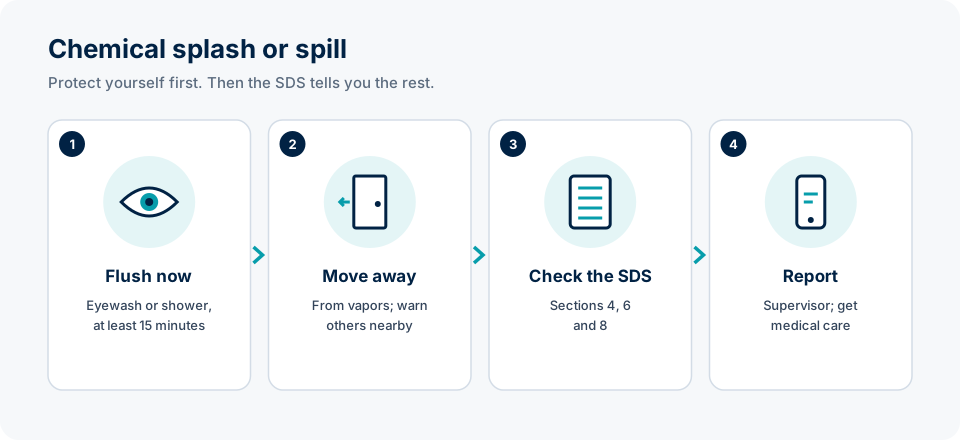
Eye or skin splash
- Eyes: go straight to the eyewash, hold your eyelids open and flush for at least 15 minutes. Remove contact lenses if you can do so easily. ANSI Z358.1 calls for eyewash stations within about 10 seconds' travel; OSHA requires suitable quick-drench or flushing facilities where corrosive materials are used (29 CFR 1910.151(c)).
- Skin: remove contaminated clothing and rinse with water. For a large splash, use the safety shower.
- Inhalation: move to fresh air. Seek care for coughing, chest tightness or shortness of breath.
Know before you need it: on your first day in a new area, find the eyewash and check that the path to it is clear.
Small spill or big spill?
You may clean up a small spill if you know what the chemical is, you've been trained, the spill kit has what the SDS section 6 asks for, and you have the right PPE.
Treat it as a large spill and get out if: you don't know what it is, it is large, it's spreading or fuming, people have symptoms, or it's in a confined or poorly ventilated space. Leave the area, warn others, close the door if safe, and call your facility's spill response or emergency number.
After any exposure
Report it to your supervisor, get evaluated (employee health or the emergency department), and bring the SDS or the product name and manufacturer. You have the right to see records of your exposure monitoring and medical records (29 CFR 1910.1020).
Key terms · tap to flip
Check your understanding
Knowledge check
Pick an answer to see the explanation. Get them all right to complete the lesson.
Part of the free MedRise Hazard Communication (GHS) Training. Built on OSHA's Hazard Communication Standard (29 CFR 1910.1200), 2024 update.