When training happens
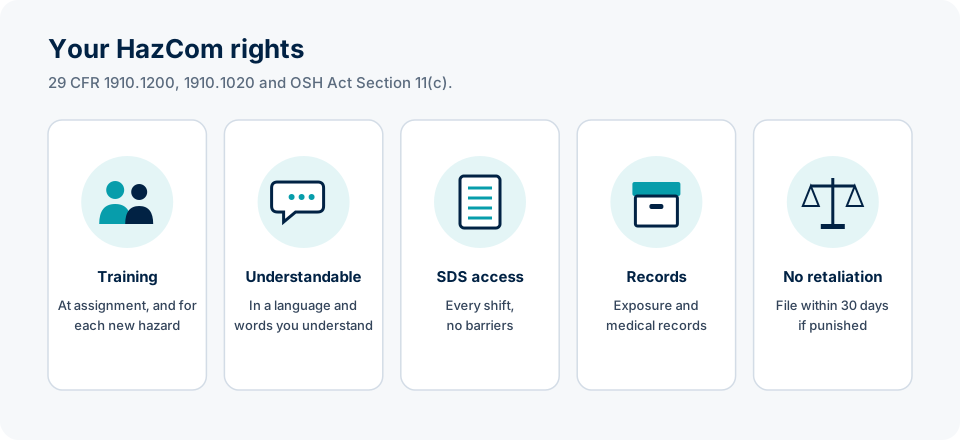
Employers train employees on hazardous chemicals in their work area at the time of initial assignment and whenever a new chemical hazard that employees haven't been trained about is introduced (1910.1200(h)(1)). The HCS doesn't set an annual retraining date, but many employers refresh it every year, and the 2024 update requires training on newly identified hazards by the compliance dates.
What training must cover
Under 1910.1200(h)(3), training includes:
- Methods to detect the presence or release of a hazardous chemical (monitoring, odor, visible signs)
- The physical, health and other hazards of the chemicals in the work area
- Measures to protect yourself: work practices, emergency procedures and PPE
- The details of the employer's program: the labeling system, the SDS and how to use them
This course covers the general topics. Your employer must add the specifics: which chemicals are in your area, where the SDS are, and your local procedures.
Understandable training
OSHA's policy is that training must be presented in a manner and language employees understand. If you didn't understand your training, ask again; that is your right.
Non-routine tasks and contractors
The written program explains how employees are told about the hazards of non-routine tasks (like cleaning a reactor vessel or an unusual spill) and how contractors working in your area are informed.
Records and retaliation
You have the right to access records of your exposure monitoring and your medical records (29 CFR 1910.1020). If you're punished for reporting a hazard or asking for an SDS, you can file a retaliation complaint with OSHA under Section 11(c) of the OSH Act within 30 days.
Review
- Read the label: identifier, signal word, hazard statements, pictograms, precautions, supplier.
- Know the pictograms; skull and crossbones means acute toxicity, the health hazard figure means long-term harm.
- SDS sections 2, 4, 6 and 8 first.
- Never mix cleaners, never use unlabeled containers.
- Flush splashes 15 minutes; evacuate for unknown or large spills.
- Ask for training you understand; report exposures.
Key terms · tap to flip
Check your understanding
Knowledge check
Pick an answer to see the explanation. Get them all right to complete the lesson.
Part of the free MedRise Hazard Communication (GHS) Training. Built on OSHA's Hazard Communication Standard (29 CFR 1910.1200), 2024 update.