The law in one sentence
HIPAA's Administrative Simplification rules (45 CFR Parts 160 and 164) set national standards for protecting health information that identifies a person, and give patients rights over that information.
Who has to follow it
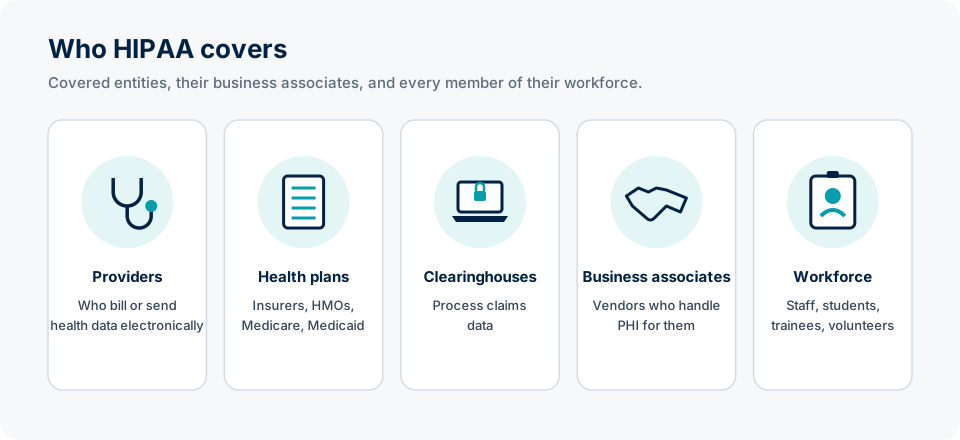
Covered entities are health plans, health care clearinghouses, and health care providers who transmit health information electronically in standard transactions, such as billing insurance. In practice that is almost every hospital, clinic and practice where you will train.
Business associates are people and companies that create, receive, keep or send PHI on a covered entity's behalf: billing companies, IT and cloud vendors, transcription services, shredding companies. They sign a business associate agreement and are directly liable for parts of HIPAA too.
You are workforce, from day one
HIPAA defines the workforce as employees, volunteers, trainees and others whose work is under the covered entity's direct control, whether or not they are paid (45 CFR 160.103). Medical students, residents, visiting students, observers and volunteers fall here. You must follow the organization's privacy and security policies, and its sanctions policy applies to you.
Rotation reality: the hospital, not your school, decides what you may access. A login that works is not permission to look.
The three rules you'll use
- Privacy Rule: who may use or share PHI, for what, and patients' rights.
- Security Rule: safeguards for electronic PHI (ePHI).
- Breach Notification Rule: what happens when unsecured PHI is compromised.
What HIPAA doesn't cover
HIPAA doesn't apply to everyone who has health information. A fitness app you download yourself, your employer's HR file about your sick leave, or a school's education records (covered by FERPA) generally sit outside HIPAA, though other laws may protect them. Inside a hospital, assume HIPAA applies.
The training requirement
Covered entities must train all workforce members on their privacy policies and procedures (45 CFR 164.530(b)) and run a security awareness and training program (45 CFR 164.308(a)(5)). That's why every hospital asks for HIPAA training before you start, and why they add their own site-specific module.
Key terms · tap to flip
Check your understanding
Knowledge check
Pick an answer to see the explanation. Get them all right to complete the lesson.
Part of the free MedRise HIPAA Privacy & Security Training. Built on the HIPAA Privacy, Security and Breach Notification Rules (45 CFR Parts 160 and 164).