The definition, made usable
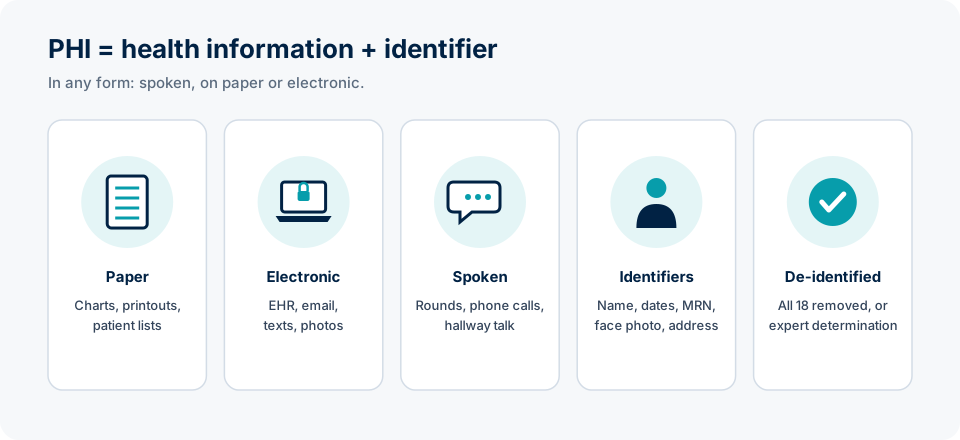
Protected health information (PHI) is information that (1) relates to a person's past, present or future physical or mental health, care, or payment for care, (2) identifies the person or could reasonably be used to identify them, and (3) is created or held by a covered entity or business associate (45 CFR 160.103). It can be spoken, written or electronic.
That means a census sheet, a sticky note with a room number and a lab value, a voicemail, a photo of a wound, and the appointment list at the front desk are all PHI.
The 18 identifiers
Under the Safe Harbor method (45 CFR 164.514(b)(2)), data is de-identified only after removing these identifiers of the patient and of their relatives, employers and household members, with no actual knowledge that what's left could identify them:
- Names
- Geographic units smaller than a state (street, city, county, most ZIP codes)
- All elements of dates except the year (birth, admission, discharge, death), and all ages over 89
- Phone numbers
- Fax numbers
- Email addresses
- Social Security numbers
- Medical record numbers
- Health plan beneficiary numbers
- Account numbers
- Certificate or license numbers
- Vehicle identifiers and plate numbers
- Device identifiers and serial numbers
- Web URLs
- IP addresses
- Biometric identifiers, such as fingerprints and voiceprints
- Full-face photos and comparable images
- Any other unique identifying number, characteristic or code
The other route is expert determination: a qualified expert documents that the risk of re-identification is very small (164.514(b)(1)).
The trap: removing the name is not de-identification. “The 34-year-old teacher from Weslaco with the rare tumor we saw Tuesday” identifies someone in a small community, and dates of service are identifiers too.
What isn't PHI
- Truly de-identified data.
- Employment records a covered entity holds as an employer (your own sick-note file).
- Education records covered by FERPA.
- Information about someone who died more than 50 years ago.
A limited data set
For research, public health or operations, a covered entity may share a limited data set (direct identifiers removed, but dates and town or ZIP allowed) only under a data use agreement (164.514(e)). It is still PHI.
Key terms · tap to flip
Check your understanding
Knowledge check
Pick an answer to see the explanation. Get them all right to complete the lesson.
Part of the free MedRise HIPAA Privacy & Security Training. Built on the HIPAA Privacy, Security and Breach Notification Rules (45 CFR Parts 160 and 164).