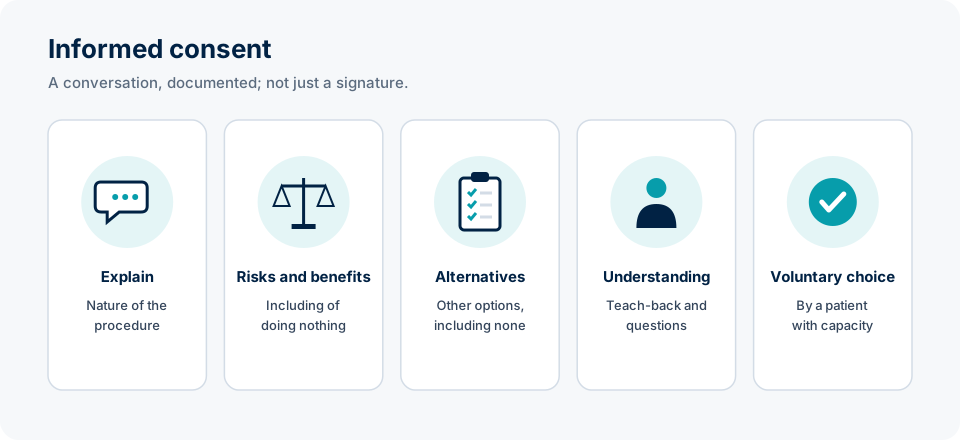
What informed consent means
Consent is a process, not a form. The clinician performing or responsible for the procedure explains, in language the patient understands: the nature of the procedure, its risks and benefits, reasonable alternatives (including no treatment), and the risks of each. The patient must have capacity and decide voluntarily. The signature documents the conversation.
Know your limits. Students and observers don't obtain procedural consent on their own. Observers in many US programs have no hands-on patient contact at all. Follow your institution's rules exactly.
Capacity
Capacity is the ability to (1) understand the information, (2) appreciate how it applies to them, (3) reason about the options, and (4) communicate a choice. It is specific to each decision and can change over time. Legal competence is decided by a court.
Surrogates and advance directives
When a patient lacks capacity, decisions go to a surrogate: someone the patient named (a health care power of attorney) or a relative in the order set by state law. Surrogates decide based on what the patient would have wanted, or their best interests when that's unknown. Advance directives, living wills, and POLST or MOLST forms record the patient's own wishes.
Family and culture
Some patients want family to receive information first or make decisions. That's acceptable when it's the patient's choice: ask them. “Some people like to hear all the details themselves; others prefer we talk to family. What would you like?”
Code status
Every admitted patient's code status (full code, do not resuscitate, do not intubate, and so on) should be clear. Have the conversation early, use plain words about what CPR involves, and document it. Never assume code status from age or diagnosis.
Delivering bad news
Prepare a private setting, find out what the patient knows and wants to know, give a warning shot (“I'm afraid I have some difficult news”), speak plainly, then pause and respond to emotion before discussing the plan. In teaching hospitals, attendings usually lead these conversations; ask to observe one.
Key terms · tap to flip
Check your understanding
Knowledge check
Pick an answer to see the explanation. Get them all right to complete the lesson.
Part of the free MedRise US Clinical Etiquette & Communication for IMGs. Built on ACGME core competencies, AHRQ TeamSTEPPS, I-PASS handoffs and federal language-access rules.