The rules
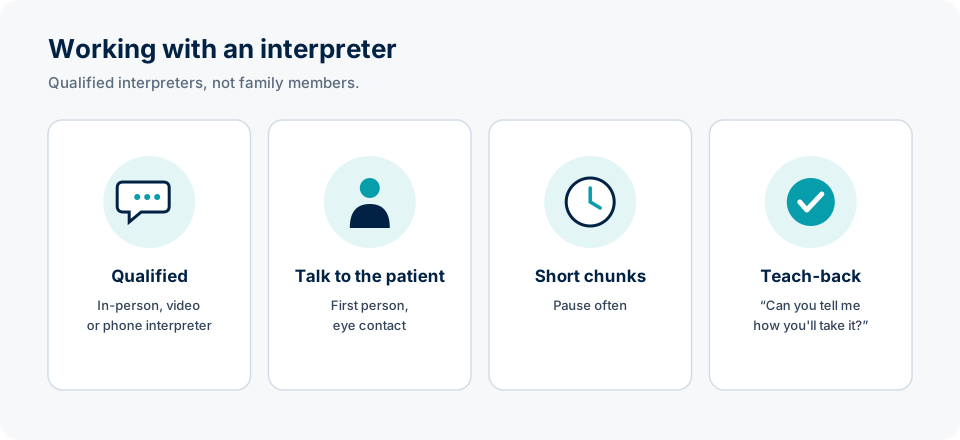
Under Title VI of the Civil Rights Act and Section 1557 of the Affordable Care Act, health programs that receive federal funding must take reasonable steps to provide meaningful access to people with limited English proficiency, including qualified interpreters, at no cost to the patient. Section 1557's rule restricts relying on an adult accompanying the patient, or a minor child, to interpret, except in specific situations such as an emergency involving an imminent threat to safety when no qualified interpreter is immediately available, or when the patient specifically asks for an accompanying adult and that's appropriate.
Being bilingual isn't the same as being a qualified interpreter. Even if you speak the patient's language, follow your hospital's policy on who may interpret; many require testing before clinicians use a second language for care.
How to work with an interpreter
- Brief the interpreter: the goal of the visit and any sensitive topics.
- Sit facing the patient. Speak directly to them in the first person (“How is your pain?” not “Ask her how her pain is”).
- Speak in short chunks and pause for interpretation.
- Avoid idioms, jokes and abbreviations.
- Expect it to take longer, and plan for it.
- Document that an interpreter was used, with their ID number if your hospital asks.
Teach-back
Teach-back confirms that you explained clearly, not that the patient is smart. Ask the patient to explain or show what they will do: “We've gone over a lot. To make sure I explained it well, can you tell me how you'll take your new inhaler?” If they miss something, explain again in a different way and check again.
Health literacy
Many adults have limited health literacy regardless of language. Use plain language, limit each visit to two or three key points, use pictures or show-me demonstrations, and give written instructions at an easy reading level.
Key terms · tap to flip
Check your understanding
Knowledge check
Pick an answer to see the explanation. Get them all right to complete the lesson.
Part of the free MedRise US Clinical Etiquette & Communication for IMGs. Built on ACGME core competencies, AHRQ TeamSTEPPS, I-PASS handoffs and federal language-access rules.