Why teams use scripts
Hierarchy and politeness make people soften warnings until they're missed. AHRQ's TeamSTEPPS program gives everyone, including students, short phrases with an agreed meaning.
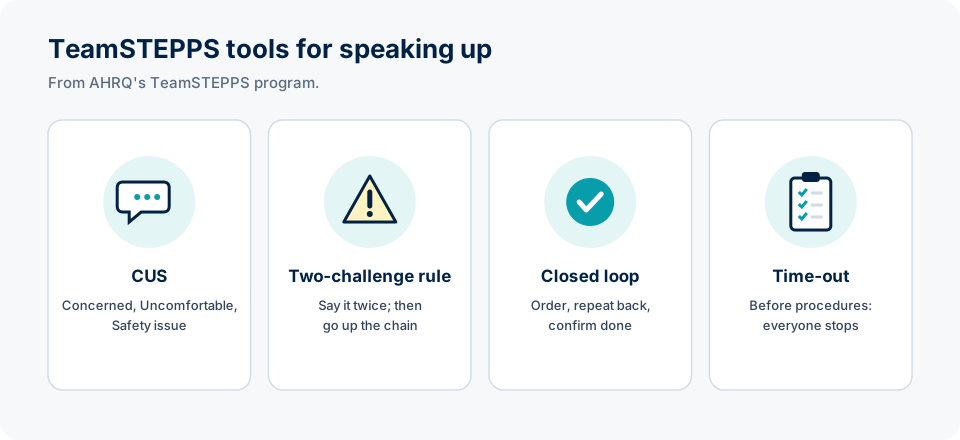
CUS
Three escalating statements: “I'm concerned about her potassium.” “I'm uncomfortable giving this dose.” “This is a safety issue; we need to stop.” In many hospitals, hearing CUS means everyone pauses.
The two-challenge rule
If you have a safety concern, state it clearly at least twice. If it's still not addressed, escalate to the next person in the chain of command. Anyone can do this, including a student.
Closed-loop communication
Sender: “Give 4 milligrams of IV morphine.” Receiver: “4 milligrams IV morphine.” Then: “4 milligrams of morphine given.” Repeat-backs catch wrong drugs, doses and routes, especially in emergencies and over the phone.
Universal Protocol and time-outs
Before invasive procedures, the Joint Commission's Universal Protocol requires a pre-procedure verification, marking the site, and a time-out where the team stops to confirm the right patient, procedure and site. Everyone participates; anyone can stop the procedure if something doesn't match.
Errors, near misses and just culture
Report errors and near misses through your hospital's reporting system. A just culture separates honest human error (console and fix the system), at-risk behavior (coach) and reckless behavior (discipline). Hiding an error is what turns a mistake into a professionalism problem.
Hand hygiene is teamwork too. Clean your hands before and after every patient contact, and accept a reminder from anyone, a nurse or a patient, with “Thank you.”
Key terms · tap to flip
Check your understanding
Knowledge check
Pick an answer to see the explanation. Get them all right to complete the lesson.
Part of the free MedRise US Clinical Etiquette & Communication for IMGs. Built on ACGME core competencies, AHRQ TeamSTEPPS, I-PASS handoffs and federal language-access rules.